Charles Babbage · 1791–1871
The man who designed the computer a century early.
Charles Babbage was born on 26 December 1791, most probably in Walworth, south London, the son of a banker. He taught himself much of his mathematics before going up to Trinity College, Cambridge in 1810, where he found the teaching so far behind the Continent that he and his friends John Herschel and George Peacock founded the Analytical Society in 1812 to import Leibniz’s notation into English mathematics.
His obsession began with a practical grievance: the printed mathematical tables that navigators, insurers and astronomers depended on were riddled with human error. From 1822 he built a working model of a Difference Engine that could calculate and tabulate polynomial functions by repeated addition, and in 1823 the Treasury agreed to fund a full-scale machine, one of the first substantial government grants for scientific research in Britain.
It was never finished. Babbage quarrelled with his engineer, Joseph Clement, over ownership of the specially made tools; the project consumed some £17,000 of public money and stopped in 1833. By then Babbage had conceived something far more radical.
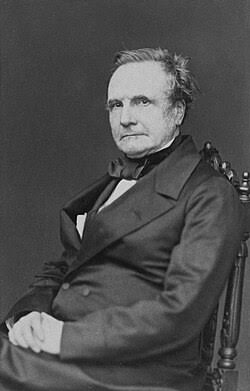 Charles Babbage, c. 1860
The Analytical Engine
From 1834 Babbage designed a general-purpose machine: a “store” for a thousand fifty-digit numbers, a “mill” to operate on them, and instructions fed in on punched cards borrowed from the Jacquard loom. It could branch and loop. Nothing like it was built until the 1940s, and it was never built by him.
Ada Lovelace
In 1843 Ada Lovelace translated Luigi Menabrea’s account of the engine and appended notes longer than the paper itself, including a method for computing Bernoulli numbers and the observation that such a machine might act on things other than number, music, for instance. The notes are why her name sits on our doctoral trophy.
Beyond machines
Babbage was Lucasian Professor of Mathematics at Cambridge from 1828 to 1839 (he never lectured), helped found the Astronomical Society, the British Association and the Statistical Society, published On the Economy of Machinery and Manufactures in 1832, devised the uniform penny post’s arithmetic, invented the cowcatcher, and campaigned loudly against street musicians.
A life, in dates
Vindicated by the Science Museum
Between 1985 and 1991 the Science Museum in London built Difference Engine No. 2 from Babbage’s own drawings, to tolerances available in his lifetime. It worked, returning correct results to 31 digits, settling a century of argument about whether the designs were sound or the man merely difficult. Half of Babbage’s brain is in the same building; the other half is at the Hunterian Museum.